
A protection symbol can be meaningful as art, prayer, memory or a cue to take care, but the drawing itself cannot guarantee physical or supernatural safety. Its meaning comes from context: who uses it, where it comes from and what responsibilities accompany it.
Before copying a striking image, learn its history. If you want a private reflective practice, you can also design an original abstract mark tied to actions you can actually take.
Start with context, not a universal dictionary
Circles, eyes, hands, knots, animals, words and geometric forms have appeared in many places and periods. Similar shapes may carry unrelated meanings. A circle can suggest unity in one setting, mark a boundary in another or simply be decorative.
Museum collections show how specific protective objects can be. The Metropolitan Museum of Art explains that ancient Egyptian amulets drew meaning from combinations of shape, material, color, inscription and ritual action. Treating one element as a timeless code removes it from that network of belief and practice.
Ask four questions: What community used this form? In what period? Was it public, restricted or sacred? Is the information coming from members of that tradition, a museum record or an unsourced graphic?
Distinguish history, faith and evidence
It is accurate to say that people believed an object protected them. That is different from claiming that research has shown the symbol prevents illness, accidents, crime or hostile forces.
The Smithsonian National Museum of Asian Art describes ancient Egyptian amulets as portable objects believed to ward off dangers and connect wearers with protective deities. Its Pocket-Sized Protectors feature also shows that animals and composite deities carried meanings grounded in a particular religious world.
You can respect the belief without presenting it as a measurable safety system. Phrase interpretations as “was associated with,” “is understood by some practitioners as” or “I use this as a reminder,” rather than as guaranteed facts.
Know when not to copy a symbol
Pause if a design belongs to a living religious or Indigenous community, requires initiation, contains sacred writing you cannot read or is connected to funerary, healing or ceremonial responsibilities you do not understand.
Some symbols have also been adopted by extremist movements or used differently across regions. Check current context before displaying a mark on a door, garment, workplace or public artwork.
When guidance is unclear, choose an original design. Cultural appreciation includes accepting that not every meaningful object is available for personal reinvention.
Choose what protection means in practice
Make the intention specific and within your control. “Keep all harm away” is impossible to evaluate. Try one of these instead:
- pause before opening the door to a stranger;
- take prescribed medication on schedule;
- leave a conversation when insults begin;
- check the stove before going out;
- ask for support before a difficult appointment;
- lock accounts with unique passwords and multifactor authentication.
The symbol can become a visual prompt for the behavior. The action provides the practical protection.
Design an original personal mark
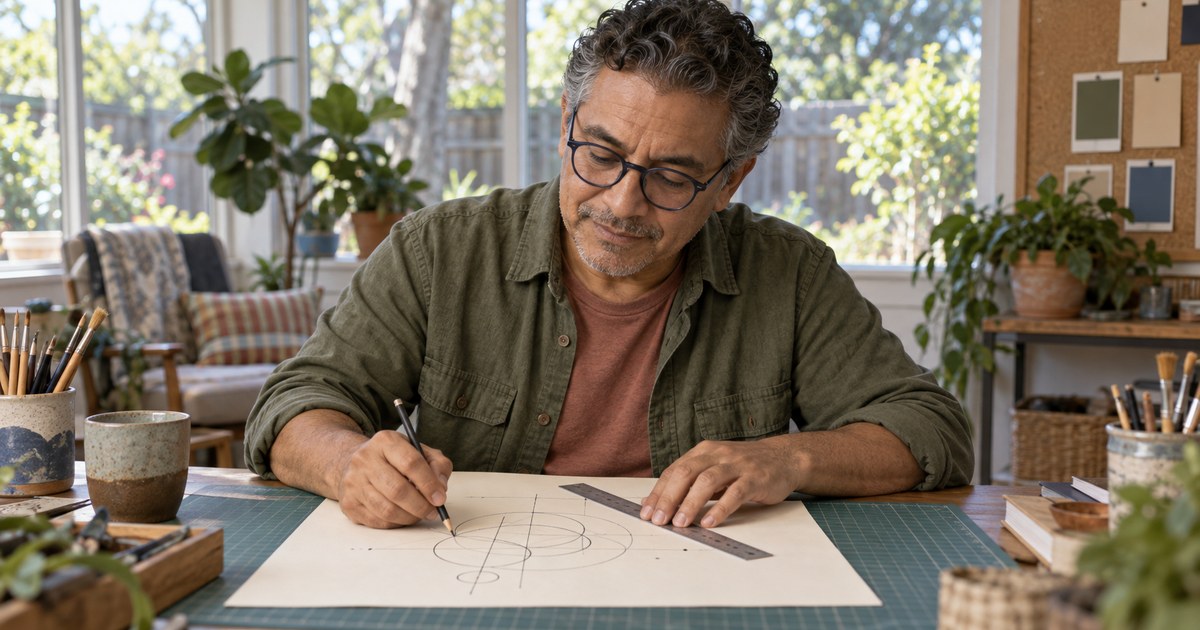
- Name one intention. Write a short phrase such as “pause and check.”
- Select two neutral forms. A line might represent a limit; an open arc might represent room to choose.
- Make three thumbnails. Combine the forms in different proportions without copying a known emblem.
- Remove unnecessary detail. A cue should remain recognizable at a glance.
- Record your meaning. Date the page and describe the action the mark should prompt.
- Review it later. If the design creates fear or obsession, retire it.
A ruler, compass or template can help with clean geometry, but perfect symmetry is not required. The exercise is reflection, not a test of spiritual worth.
Try a simple boundary-card exercise
Draw a rectangle with one opening. Inside it, place a small neutral shape that represents your attention. At the opening, draw a short line that can be moved or erased.
Use the card to ask: What am I willing to let in? What needs a pause? Who has earned access? What real step supports the answer? The open boundary avoids the fantasy of total control while keeping choice visible.
If you prefer established spiritual imagery, our guide to chakra symbols and visual meaning explains why colors and forms should be read in context rather than as a diagnosis.
Label sourced symbols honestly
| Label | What to include | Why it matters |
|---|---|---|
| Tradition | Community, region and time period | Prevents a universal claim |
| Source | Museum, scholar or community authority | Makes the interpretation checkable |
| Status | Historic object, living practice or personal adaptation | Separates categories |
| Limits | Uncertainty, restricted use or disputed meaning | Avoids false confidence |
A British Museum record for a post-medieval ring combining a serpent and pentagram, for example, documents one particular object, date and interpretation. It does not establish one meaning for every serpent, circle or five-pointed star.
Use safe materials and placement
Ask permission before marking shared walls, rented property, public spaces, another person or an animal. Use skin-safe products only as directed; do not burn or scar a symbol into skin. Keep paint, solvents and carving tools ventilated and away from children and pets.
If you burn paper or use candles, ordinary fire rules still apply: stable nonflammable surface, ventilation, water nearby and continuous adult attention. A safer option is pencil, removable tape or a digital image.
Do not let a symbol replace protection
A mark cannot replace a working smoke alarm, door lock, helmet, medical diagnosis, legal order, cybersecurity practice or emergency plan. If a person threatens you, document what is safe to document and contact appropriate local support. If you smell gas, have new severe symptoms or face immediate danger, leave and seek qualified help.
Likewise, fear of a psychic attack can become consuming. Our guide to psychic attack fears and grounding offers practical checks and support options without confirming an unseen cause.
Notice whether the practice is helping
A useful symbol may help you pause, remember a value or begin a familiar calming routine. Stop and seek support if drawing, redrawing or checking it becomes compulsory, interferes with sleep or makes you believe disaster will occur unless the design is perfect.
You remain allowed to change the mark. Its purpose is to support deliberate action, not control you.
Let meaning and responsibility stay together
Protective symbols are part of rich artistic and spiritual histories. Respect begins with accurate sourcing and humility about what you do not know.
For a personal practice, make the drawing original, connect it to a concrete safety behavior and treat it as a reminder rather than a shield. Meaning can be powerful without becoming a promise.
Frequently asked questions
Do protection symbols guarantee safety?
No. A symbol may support prayer, reflection or memory, but it cannot guarantee protection from illness, accidents, crime or supernatural harm.
Can I copy any protection symbol I find online?
No. First identify the community, history and conditions of use. Avoid restricted or sacred imagery when you lack permission or reliable context.
What is the easiest personal protection symbol to draw?
Combine two simple neutral forms into an original mark, then assign it one practical reminder such as pausing, locking a door or contacting support.
Does a circle always mean protection?
No. Circles carry many meanings across art, religion and ordinary design. Interpret a circle through its specific cultural and historical context.
Where can I place a personal symbol?
Use paper, a journal or another surface you own. Ask permission before marking shared property, another person, an animal or a public place.
When can a symbolic practice become unhelpful?
Step back if repeated drawing or checking feels compulsory, disrupts sleep or creates fear that harm will occur unless the symbol is perfect. Professional support may help.
Ah, yes, because drawing a circle or pentagram on your wall is obviously going to ward off any existential threats. Next time I feel anxious, I’ll just chalk it up to a lack of geometric doodles in my life.
Fascinating read! I had no idea that symbols like the Circle and the Pentagram have such deep historical and spiritual significance. The exploration of these symbols from various cultural perspectives is truly enlightening.
It’s intriguing how the article blends various elements from Christian, Jewish, and occult traditions. Each symbol’s rich history and multiple meanings highlight the cross-cultural exchanges that shaped their development.
So, if I draw a Pentagram on my living room floor, will it summon a protective spirit or just give me a reason to finally clean my carpets? Either way, my house is about to get a lot more interesting!
The post’s claims about the efficacy of these symbols seem unsubstantiated. How can one be sure that these symbols offer any protection without any scientific evidence? It sounds more like superstition than fact.
I’m inclined to agree with Skeptical Scholar. While these symbols are culturally significant, their purported protective properties lack empirical evidence. We should approach such claims with a healthy dose of skepticism.
Science can’t explain everything in this world. Symbols hold power through belief and tradition. Many cultures have relied on these symbols for centuries, and that should not be easily dismissed.