

Yoga can be part of a strength-building routine, but a pose name is not a promise of a particular result. The practice should fit your experience, health and comfort—not require you to force your body into a photograph.
If you are drawn to yoga for both movement and reflection, you can make room for both. Keep physical goals separate from spiritual interpretations, and ask for help learning unfamiliar positions.
What kind of strength are you looking for?
You might mean muscular strength, steadier balance or feeling more able to approach a difficult day. These are different aims, and one does not automatically prove the others.
MedlinePlus describes yoga postures as movements that can support strength, flexibility and balance. Styles vary in intensity; this does not mean every class or every pose provides the same training.
For a personal goal, name something you would like to work toward and discuss it with an appropriately qualified instructor. You do not need to define progress by how long another person holds a pose.
Before trying the five poses
The National Center for Complementary and Integrative Health advises learning with a qualified instructor. Yoga can cause injuries, and learning alone without supervision has been associated with greater risk.
If you have a health condition, injury or pregnancy-related concern, ask your healthcare professional about appropriate activity and tell your instructor what guidance you received. A beginner label does not make every position suitable for every person.
The descriptions below help you recognize the poses and prepare questions. They are not a complete sequence, an individualized exercise prescription or instructions to hold each position for a fixed time.
1. Tadasana: Mountain Pose
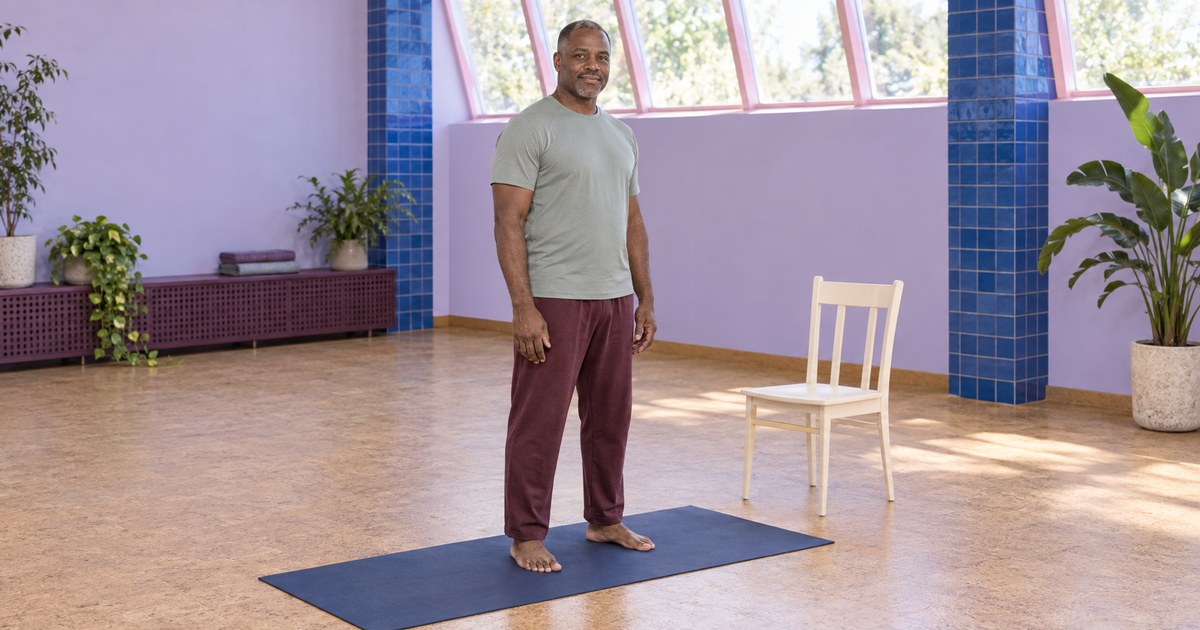
Mountain Pose is a foundational standing posture. Rather than trying to look rigid, use instruction to explore your alignment and a comfortable standing base.
Yoga Journal shows variations with feet apart, at a wall and in a chair. Ask which version fits you, especially if standing balance is difficult. Its basic instructions use a forward gaze; closing your eyes is not a requirement.
The image of a mountain may serve as a personal reminder of steadiness. It is not evidence that energy is entering your feet from the earth, and you do not need to feel a special sensation to participate.
2. Virabhadrasana I: Warrior I
Warrior I is one particular posture in the Warrior family. Use the full name when asking for instruction so you and your teacher are discussing the same position.
Yoga District’s Warrior I guide includes a shorter-stance modification with hands at the hips. A teacher can help you decide on an appropriate stance and arm position instead of assuming the deepest or longest version is best.
Counting to ten once does not establish that you have become stronger. Treat learning the movement and choosing a manageable effort as the immediate task.
If the warrior image helps you reflect on courage, that meaning can be yours. It does not require enduring pain or proving that you are emotionally strong.
3. Anjaneyasana: Low Lunge
Anjaneyasana is commonly called Low Lunge. The low-lunge form places the back knee on the floor; an instruction simply saying “crescent” may leave the intended variation unclear.
Ask your instructor to demonstrate the exact version and help you decide whether kneeling is appropriate. If it is not, you can ask for another option rather than insisting on this pose.
Some spiritual interpretations connect an open-chest image with the heart chakra. That is symbolism, not a guarantee that a lunge creates unconditional love or changes a relationship.
Our guide to chakra reflection and everyday care explains how to explore that language without treating it as a medical finding.
4. Vrksasana: Tree Pose
Tree Pose involves a standing balance, with variations that reduce its demands. Yoga Journal describes keeping the lifted foot lower, using support and practicing a seated version.
Learn an appropriate variation before attempting to balance unaided. In a standing version, do not press the raised foot directly against the supporting knee. Keeping your eyes open and looking at a steady point is a practical starting instruction.
You do not need to deliberately sway or close your eyes to make the tree metaphor work. Nor should this pose be treated as a treatment for a spinal problem.
Needing a wall, a chair or another variation does not make your practice less meaningful.
5. Balasana: Child’s Pose
Child’s Pose is often offered as a resting posture. Cleveland Clinic’s guide describes it as a restorative stretch, but a pose being called restful does not mean you have to find it comfortable.
If folding or kneeling does not work for you, ask for a different rest position. You do not owe a class a particular shape before you are allowed to pause.
There is also no required emotional experience. You may feel quiet, distracted or unchanged. You do not have to imagine being in a womb or expect anxiety to leave your body through the floor.
Choose a practice you can actually use
Before joining a class, ask about its pace, how modifications are offered and whether you can rest or decline a pose. Explain what you are hoping to learn.
A useful first question is specific: “Can you help me find a version of this that fits my balance?” is clearer than “Am I bad at yoga?”
Afterward, note what was understandable and what you want explained again. If an instruction was confusing, bring that question to the next conversation instead of assuming you should already know.
MedlinePlus advises stopping and resting when you feel pain or fatigue. Do not turn discomfort into a spiritual test. Seek healthcare advice about concerning symptoms rather than asking a pose to diagnose or resolve them.
Breathing and reflection are not endurance tests
NCCIH’s yoga safety guidance recommends that newcomers avoid forceful breathing and extreme practices. More intensity is not automatically more useful.
If meditation is part of a session, you can ask how it will be introduced and what alternatives are available. Our guide to meditation without strain offers a related approach to attention without self-criticism.
Yoga may be something you enjoy alongside other support. It does not replace professional care for anxiety, pain or another health concern, and you have not failed if you need that care.
Frequently asked questions
Can yoga help build strength?
It can support physical fitness, including strength, but styles and demands differ. These five pose descriptions are not a complete strength program or a promise of results.
Do I have to close my eyes in Mountain or Tree Pose?
No. Eyes-closed practice is not required here. Learn a suitable version with an instructor, especially if balancing is difficult.
Is Anjaneyasana the same as every crescent lunge?
Names can leave the variation unclear. This guide uses Anjaneyasana for Low Lunge, with the back knee down. Ask your instructor to demonstrate the intended form.
What if Child’s Pose is uncomfortable?
You can choose another rest position. Ask for an appropriate alternative rather than forcing yourself to kneel or fold.
Does a yoga pose open my heart chakra or remove anxiety?
Chakra language can have personal spiritual meaning, but it is not a guaranteed physical or emotional outcome. Yoga does not replace appropriate healthcare.
How long should I hold each pose?
There is no universal hold time in this guide. Learn an appropriate practice for your needs with a qualified instructor, and do not push through pain or fatigue.
The descriptions of the yoga poses are quite detailed and seem helpful for those looking to improve both physical strength and mental clarity. It would be interesting to know the additional benefits of these poses when they become part of a regular practice.
This article highlights some fundamental yoga poses that are beneficial for overall well-being. They appear to be accessible even for beginners, which is encouraging for those new to yoga.
The connection between physical posture and inner strength is well-explained here. It would be useful to have some guidance on how often one should practice these poses to notice significant benefits.
I appreciate the emphasis on grounding and mental clarity in these yoga poses. It’s clear that these practices are designed to support both physical and emotional health, which is a holistic approach.
The article offers a good overview of yoga poses that enhance strength and flexibility. Including information on modifications for different skill levels would make it even more valuable.