

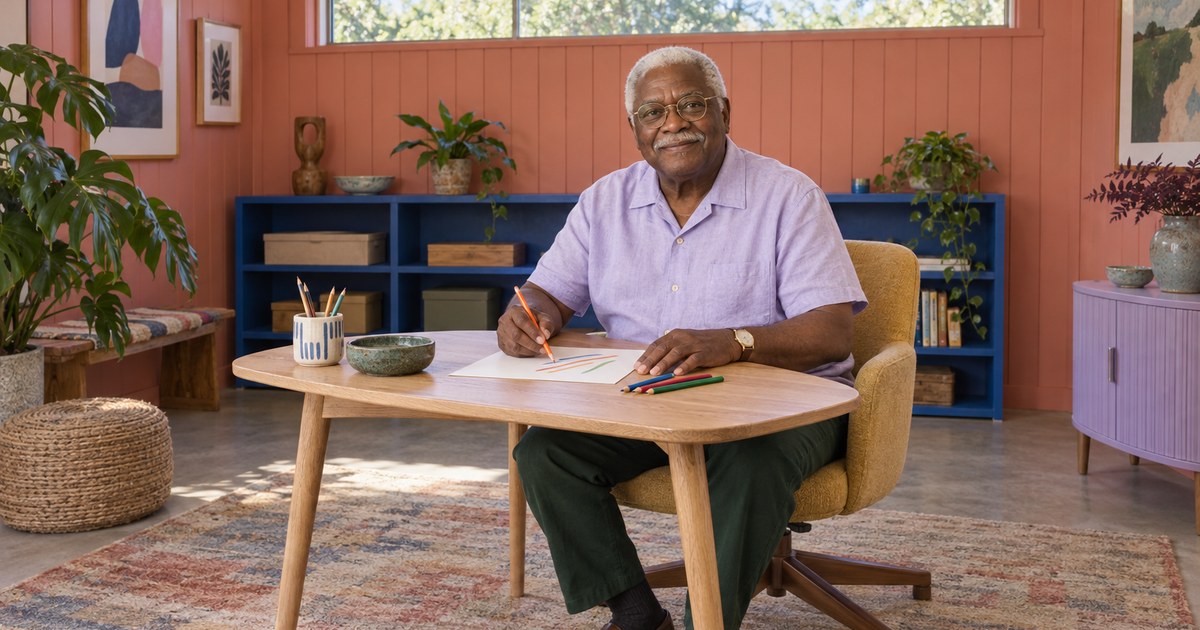
You can enjoy color as a source of personal meaning without treating it as medicine. A favorite scarf, a familiar landscape or a simple drawing can be part of everyday reflection. None has to reveal a hidden need or produce a particular mood.
The term color therapy can suggest more than personal preference. This guide focuses on a low-pressure way to explore colors you like, not on treating illness with colored light or claiming that thoughts emit healing vibrations.
Color associations are not the same as treatment effects
A 2020 study of color-emotion associations asked 4,598 people from 30 nations to associate color terms with emotions. The researchers found shared patterns alongside differences related to language and geography.
That study examined associations; it was not a trial showing that wearing a color treats anxiety, changes a relationship or improves health. Recognizing a shared association also does not tell us what every individual will experience.
A later study across adult age groups likewise found broadly similar patterns with differences by age. Its authors called for further work on whether such associations reflect what people actually feel when exposed to color. Keep that question separate from claims of a guaranteed effect.
Let your own response matter
You might enjoy one shade of blue and dislike another. A color can remind you of a person, place, object or occasion, and the setting may matter more to you than a chart’s label.
There is no requirement to discover why you like a color. Preference can remain preference. If an interpretation does not fit, you do not need to accept it because a reader or website calls it your energy.
Our aura-color interpretation guide explains another use of color symbolism. It does not turn a favorite color into a diagnosis or a reliable description of your character.
Eleven colors: prompts, not prescriptions
The following questions are original reflection examples. They retain the range of colors discussed in this guide without assigning each a power. Use any prompt with any color, change the pairing or ignore the list.
Black: privacy by choice
If black feels comfortable to you, use it as a reminder to consider privacy: “What would I prefer to keep to myself?” Clothing does not prevent unwanted attention, and someone else’s behavior is not your fault because of what you wear.
Brown: something familiar
Brown might bring a favorite object or place to mind. Ask, “What feels familiar and useful today?” You do not need to interpret the association as physical grounding or assume it makes you appear friendly to others.
Red: a chosen action
You could pair red with the question, “What do I want to speak up about?” The action is yours to choose. Your right to occupy space does not depend on a color, and red does not communicate sexual consent.
Pink: kindness with boundaries
If you like pink, ask, “What would kindness look like without ignoring my limits?” A color cannot make another person open up, welcome touch or become emotionally available. Ask rather than infer.
Orange: room to experiment
Orange can be a playful cue if that association suits you: “What small creative idea would I enjoy trying?” It does not need to increase energy, change sexuality or silence self-criticism to be worth enjoying.
Yellow: one priority
You might use yellow to mark an important note or ask, “Which task matters most to me?” A highlighted reminder can be practical. The color does not establish a boundary for you or reveal a fixed life purpose.
Green: giving and receiving
If green brings care to mind, consider, “What help can I offer, and what help do I need?” The answer may involve a conversation or practical assistance. A green object does not attract a healing force or make you responsible for healing others.
Blue: words you choose
You could pair blue with writing a sentence you want to communicate clearly. Notice the words, not a promise about how they will be received. Blue cannot guarantee agreement, calmness or protection from a negative reaction.
Turquoise: personal expression
If turquoise appeals to you, ask, “What part of my interests would I like to express?” That may be a hobby, a piece of clothing or a work idea. You do not need to find your vocation through a color reading.
Purple: meaning and imagination
Purple may fit a reflective or spiritual setting you enjoy. Ask what the setting means to you. A meaningful association is not evidence of contact with angels or deceased loved ones, and no shade guarantees a particular dream.
White: space for a next step
A blank page can be a useful starting image if you like it. Ask, “What would I like to put here?” White does not make thoughts morally pure, and darker colors do not make a person less good or less spiritual.
Try one small, reversible change
Choose something already available: a pencil, a piece of fabric, a notebook cover or an object you enjoy looking at. There is no need to repaint a room, replace your wardrobe or book a reading before you begin.
- Pick a color or combination you find comfortable.
- Use it in a small, ordinary way, such as making a mark on paper.
- Notice whether you enjoy it in that setting.
- Keep it, change it or stop without assigning a score.
You do not need to stare, close your eyes or use a special lamp. If a visual activity is unpleasant, leave it. Texture, sound or a written word can serve your reflection instead; this is not a test of color perception.
If your mood changes, avoid assuming the color caused it. Many things may have happened during the same period. A simple preference experiment can tell you what you want around you without becoming a claim about treatment.
Color exploration is not clinical light therapy
NIMH’s seasonal affective disorder guide describes bright-light treatment for winter-pattern depression. That involves a different purpose and approach from choosing colored clothes, decor or symbolic associations.
Discuss treatment options with a health professional. NIMH notes that some eye conditions and medicines that increase light sensitivity require particular consideration or supervision. This article provides no lamp recommendation, exposure schedule or do-it-yourself treatment protocol.
If low mood is persistent, worsening or interfering with life, seek appropriate support rather than waiting to find the right color. You do not have to prove that your difficulties are serious enough to deserve care.
Keep the enjoyment; question the guarantee
You may value a spiritual interpretation, an aesthetic choice or a creative activity. Ask for clarity if someone turns that interest into a promise about health, money, relationships or protection.
A paid color reading is not necessary to choose what you like. If you choose one for reflection, you remain free to disagree, decline purchases and stop. Our guide to psychic perspective and its limits offers questions about keeping decisions in your own hands.
Frequently asked questions
Does liking a color reveal what treatment I need?
No. A preference or symbolic association is not a health assessment. Seek appropriate professional advice about symptoms or treatment.
Do colors mean the same thing to everyone?
No. Research finds shared associations as well as differences. Your response to a shade or setting does not have to match a chart.
Are the eleven prompts universal color meanings?
No. They are original optional reflection questions. You can change the pairings, use a different prompt or skip the list.
Do I need to buy anything to explore color?
No. Use a familiar object or material you already have. A reading, new wardrobe or room makeover is not required.
Is choosing colored decor the same as light therapy for depression?
No. Clinical bright-light treatment has a different purpose and approach. Discuss its suitability and risks with a health professional rather than improvising a treatment.
What if a color does not improve my mood?
You have not failed. You can simply enjoy it, choose another activity or stop. Persistent or worsening low mood deserves support, not pressure to find a perfect shade.
While the article is well-written, the claims about colors affecting emotions and spiritual connections sound like pseudoscience. Where is the empirical evidence supporting these assertions? Without rigorous scientific validation, these concepts remain dubious at best.
This is a fascinating overview of color therapy! I’ve always found colors to be deeply impactful on my mood and mental state. The idea that different colors can actively influence our feelings and even spiritual connections is intriguing. Thank you for sharing such a comprehensive guide!
I agree! Colors have a subtle yet profound effect on my daily life. This article really opened my eyes to new possibilities of incorporating them more intentionally.
Oh great! Now I have to worry about choosing the right color for my water bottle to achieve emotional equilibrium. Next thing you know, they’ll be selling ‘therapeutic’ colored socks to balance our chakras.
The concept of color therapy is quite interesting, but I wonder how much of its effectiveness is due to placebo. If people believe that colors can influence their mental state, perhaps that’s what’s really making the difference.
You have a point. The placebo effect is powerful. However, if people feel better and more balanced by using color therapy, does it really matter whether it’s due to the placebo effect or some inherent property of colors?
Color therapy seems like a benign and potentially helpful practice for those looking to enhance their mood and overall well-being. While it may not replace traditional treatments for serious conditions, it’s certainly a low-risk way to experiment with self-care.