

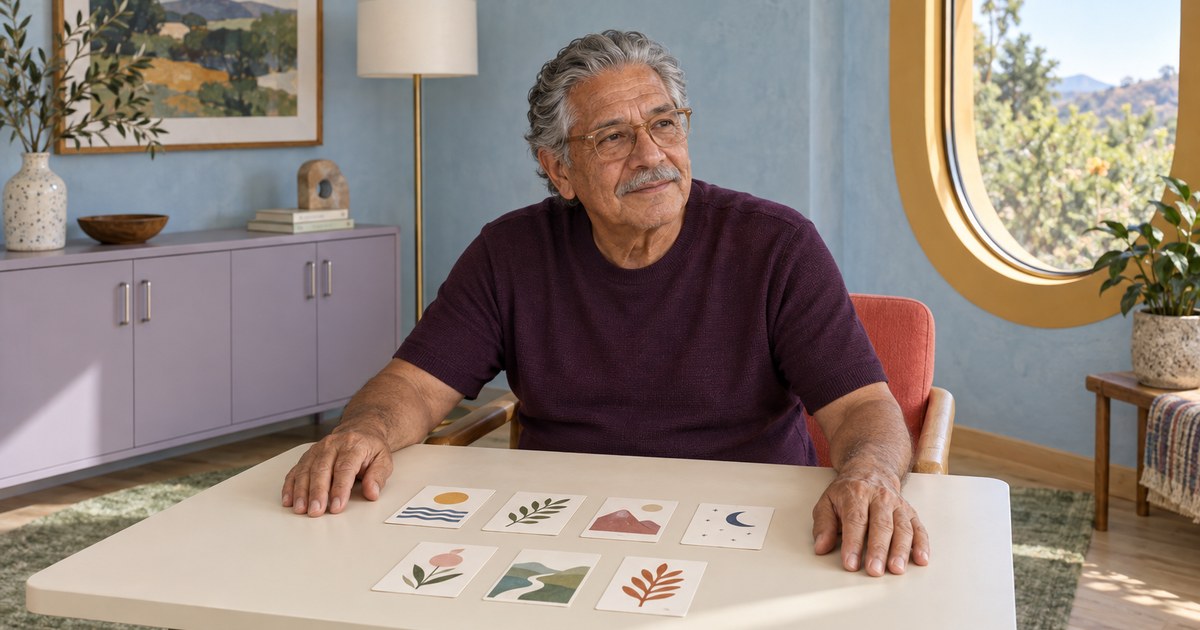
A tarot spread cannot make a relationship mutual or turn a hope into a promise. If twin-flame language is meaningful to you, use this seven-card exercise to examine your own questions—not to certify that someone is “the one.”
The positions below are an editorial adaptation of this page’s relationship spread. They are optional writing prompts, not an authenticated traditional method, a prediction system or a psychological assessment. You can use a deck you already have or answer the questions without cards.
What does twin flame mean in this exercise?
Here, “twin flame” refers to a spiritual interpretation of an unusually meaningful connection. Ideas about a shared soul, reincarnation or a destined meeting belong to belief, not to facts this spread can establish.
You do not need to adopt those ideas to consider what you want in a relationship. Nor do you need to prove that a connection is spiritually special before taking your feelings seriously.
The possible value of the exercise is limited: it gives you a structure for putting thoughts into words. You may find that useful, unhelpful or simply interesting. It does not guarantee clarity, a better relationship or future happiness.
For a broader discussion of relating to someone you feel strongly drawn to, see connection, trust and mutual choice.
Set up a reflection, not a verdict
Choose a quiet moment when you want to explore the questions. If you use cards, shuffle and lay out seven in any arrangement you can follow, assigning one position to each question below. No special purchase, ritual or birth information is required.
For each position, write two short notes: what the image brings to mind, and what you actually know about your situation. Keep these separate. “This picture reminds me of closeness” is an association; “We agreed to meet on Saturday” is an observable arrangement.
Leave room for “I do not know.” You do not need to invent an answer or pull more cards until an uncertain situation feels settled. If the exercise is making you more upset, put it aside.
Card 1: What am I hoping this connection will offer?
Replace “Are they the one?” with a question about your own hope. You might want companionship, shared interests, affection, stability or a chance to explore a relationship at a comfortable pace.
Be specific without assigning the other person a duty to fulfill the hope. “I would like a partner who enjoys making plans together” is different from “This person must become my lifelong partner.”
If the card suggests a happy scene to you, name the quality you appreciate in it. Do not turn that appreciation into a prediction about someone you barely know.
Card 2: What commitment has actually been discussed?
Write down what each person has said about the relationship. Are you dating, considering a first meeting, maintaining a friendship or no longer in contact? If your expectations differ, record that difference plainly.
A card is not evidence that someone wants marriage, exclusivity or reconciliation. Those are matters for freely chosen agreements, not assumptions about hidden feelings.
You may realize that there has not yet been a conversation. That is information, not a failure of the spread. Ask an appropriate question only when contact is welcome; respect an existing refusal or request for no contact.
Card 3: Which practical difficulty needs attention?
Consider a real issue such as scheduling, distance, incompatible plans or an unresolved disagreement. Describe the issue without assuming that it is a spiritual blockage.
Do not nominate a friend or family member as an enemy because a card seems challenging. Someone else’s concern may be worth hearing, even if you later disagree with their view.
Ask what is within your control and what is not. You may be able to clarify your availability; you cannot make another person want the same future. A difficult answer need not be hidden behind a more reassuring interpretation.
Card 4: What perspective have I not considered?
The American Psychological Association describes confirmation bias as favoring information that fits existing expectations while overlooking contrary evidence. That is a useful caution when you strongly want a particular answer.
For this position, try naming an alternative explanation. A warm message may be friendly rather than romantic. A delay may leave the answer unknown rather than prove rejection or a destined reunion.
You can ask a trusted person for perspective without giving them control of your decision. Choose someone who can discuss concrete details, not simply reinforce whichever story you most want to hear.
Card 5: What would developing this relationship involve?
Imagine an ordinary next step rather than a perfect future: a mutually welcome conversation, a shared activity or more time to learn what each person wants.
What would that step require? Think about availability, willingness and any agreement that still needs to be made. Do not assume that a powerful feeling settles practical differences.
If you also use astrology, keep the interpretation separate from the person’s actual choices. You do not need their birth time, date or location for this exercise, and should not pressure them to share private information.
Card 6: What matters enough that I should name it?
Replace “How do I win?” with a question about what you want your own life to include. You might care about where you live, whether you want children, how you spend your time or what kind of commitment you prefer.
A relationship is not a prize you earn by abandoning important parts of yourself. At the same time, naming your preferences does not require the other person to adopt them.
Distinguish a flexible preference from a genuine incompatibility. You may need more thought or a conversation. There is no card that removes the need for either person’s honest answer.
Card 7: What is one realistic next step for me?
Do not ask the final card to promise that someone will make you happy forever. Instead, choose a step within your control: write down an unanswered question, keep an existing plan, speak to someone you trust or decide not to pursue contact.
Your next step can also be “nothing today.” A reflection exercise does not create a deadline. You can take time before making a significant decision.
Finish with a sentence that separates preference from prediction: “I hope for this, I currently know this, and I choose to do this.” Leave another person’s choices out of the part you control.
Bring useful questions back to real life
The NHS relationship guidance encourages open communication and listening. Where a conversation is safe and welcome, discuss the relevant question directly rather than presenting a card interpretation as the answer.
You do not have to share the spread or persuade someone to believe in it. The exercise may remain private. What matters is not agreement with the imagery, but how you handle the actual issue.
Our six relationship-tarot questions offer a separate question-based approach if you prefer not to use a seven-position layout.
Keep safety and paid advice outside the cards’ authority
If you feel threatened or controlled, do not use a favorable reading to dismiss the concern. The National Domestic Violence Hotline offers information and individualized safety support. A card spread is not a safety assessment, and you do not have to confront someone to prove your interpretation.
If you choose a paid reading, clarify its price and limits first. Do not accept a claim that an urgent additional purchase is needed to preserve a destined relationship. The Federal Trade Commission advises resisting immediate-payment pressure and checking with someone you trust before acting.
A reader may offer an interpretation, but they cannot provide another person’s consent or make your decision for you. You remain free to disagree, stop the exercise and choose a different kind of support.
Frequently asked questions
Can this spread confirm that someone is my twin flame?
No. It is an optional reflection format, not a test of spiritual identity, compatibility or destiny.
Do I need seven physical tarot cards?
No. You can answer the seven questions as writing prompts. A deck, a paid reading and another person’s birth details are not required.
Can the commitment card reveal what someone secretly wants?
Do not treat an interpretation as evidence of hidden wishes. Commitment depends on what people freely communicate and agree to.
Should I draw again if I dislike an answer?
You do not need to repeat the exercise until it reassures you. Leave uncertainty unresolved, take a break or seek a grounded perspective.
Should I stop talking to people who question the relationship?
A card does not justify treating concerned friends or family as obstacles. Consider what they actually say and keep your own judgment.
What should I do after the seventh card?
Choose a realistic step within your control, or decide to wait. Do not use the spread to override refusal, safety concerns or another person’s choices.
So, in order to find true love, all I need is a deck of tarot cards and the moon sign of my crush? Who knew it was that simple! Now, where did I put my crystal ball?
This article offers a fascinating perspective on love and relationships, blending traditional notions with spiritual elements. The tarot card spread provides a structured approach to exploring one’s romantic connections, which could be incredibly useful for those seeking deeper insights.
Absolutely! The combination of emotional introspection and tarot could yield profound personal revelations.
This is just another example of pseudoscience trying to infiltrate our understanding of relationships. Relying on tarot cards and astrology to determine if someone is ‘the one’ is nonsensical and misleading.
Interestingly, the article touches on how important it is to understand the influences and past conflicts that shape our relationships. These personal introspections, whether assisted by tarot or not, might be the key to understanding our romantic inclinations.
I find it amusing how the article suggests consulting a psychic for relationship advice. Are we in the 21st century or the Middle Ages? Real relationships are built on communication, trust, and mutual understanding, not mystical card readings.